Viewing entries in
how to

19 Comments

Using Zettelkasten and Tinderbox to Document a Literature Review

As a designer, I developed a design process that I trusted in times when I was thrown a gnarly problem and wasn’t sure how to solve it. Trusting in my process gave me something to do toward a solution. It was working the process, never some brilliant stroke of insight, that got me through to a place of originality and creativity.

As a scholar, I must develop an academic process that I can trust for the gnarly problems I’m thrown (or more likely, that I create for myself). To develop this process, I have sought to understand how others discover articles, read them, take notes about them, reference those notes, and write something original and creative as a result.

I have realized lately that a process is emerging. I am trusting it and it seems to be working. In reciprocity for all those who have shared their processes for me to discover, I have decided to share a bit of my own. Warning: this is very rough. I sat down and recorded four parts over the course of an afternoon. There’s no editing, no retakes, just me talking through what I’m doing right now. It’s highly boring and at the same time, I’ve sat and watched many similar videos as I was trying to find my own path and found them invaluable.

The tools I mention in these videos are:

Nearly 45 minutes of walkthrough follows in the following four Youtube videos… enjoy?

19 Comments

Comment

Reading is Useless: A 10-Week Experiment in Contemplative Reading

paper.png

This morning, I published a reflection on a 10-week "contemplative reading" experiment I conducted last quarter. By contemplative reading, I mean I paid attention to the experience of reading itself alongside paying attention to the text I was reading. It was a transformative experience for me and I hope that I'll continue to prioritize this way of reading as my coursework continues. Here it is:

Reading is Useless: A 10-Week Experiment in Contemplative Reading

I hope you are enriched by this reflection. Please let me know what thoughts or experiments it inspires in you.

Comment

2 Comments

Reading Strategy: Annotations


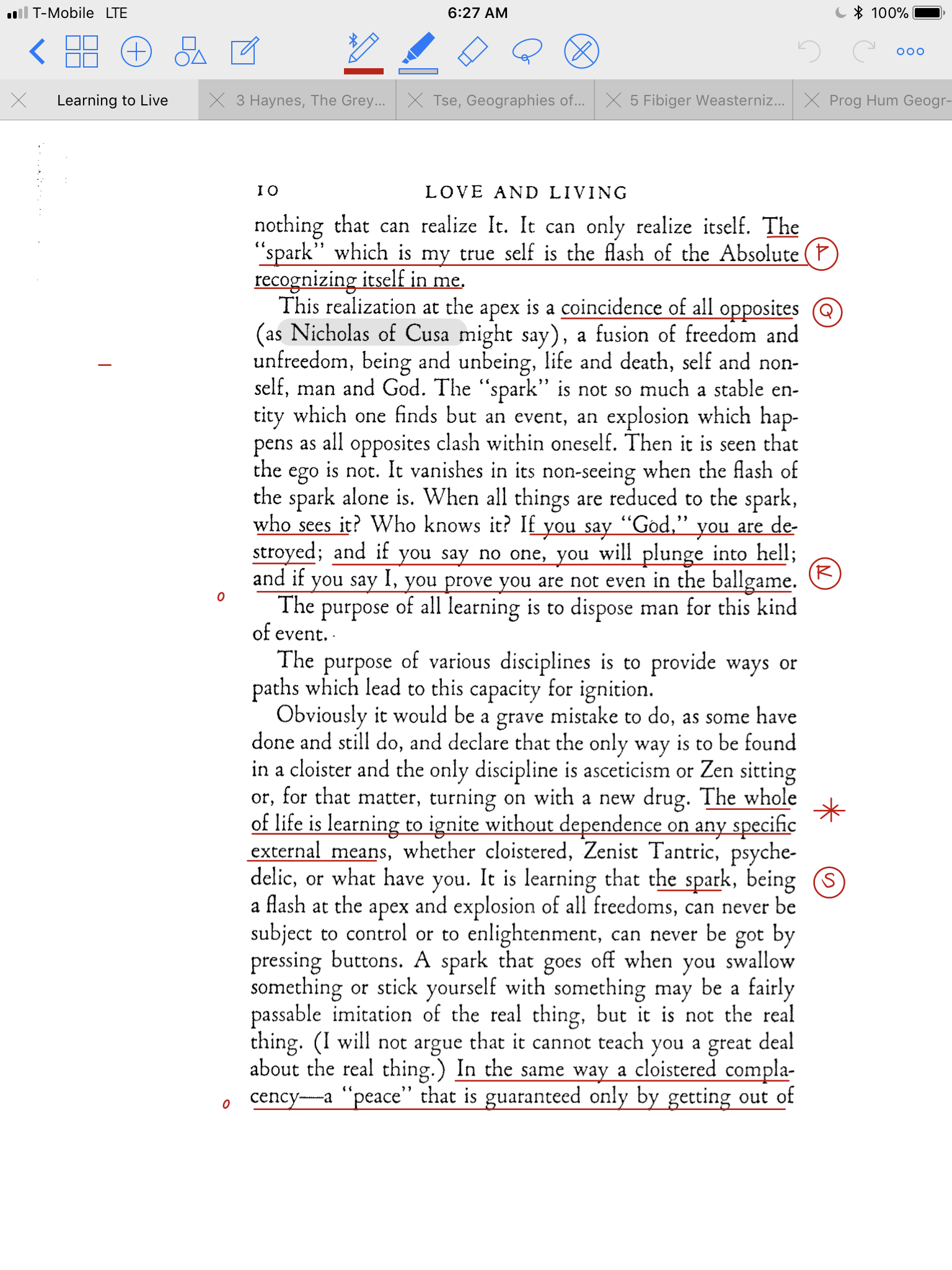
The above image is a page from Thomas Merton's book, Love and LivingI would like to use it as a reference to demonstrate how I'm annotating my academic reading these days. 


underline.png
 

Strategy 1: Underlining passages that resonate. 

I'm a heavy underliner. I used to feel a bit embarrassed about it as if I weren't smart enough to only highlight the most important things. Or, that I wasn't skilled enough to remember everything. But now, I look at underlining as a way to relate to the text. Almost the same as if I were to nod my head in understanding while talking to someone. 


gray-highlight.png
 

Strategy 2: Highlighting confusing parts.

As I mentioned last week, I've started a shameless habit of marking anything I don't understand while I'm reading. It could be that I get the gist of it, but wouldn't really be able to explain it. Or that I have no idea at all and need to look it up, which was the case here. I see these highlights as evidence of paying good attention and being curious. 


hyphen.png
 

Strategy 3: Marking when I'm distracted.

A habit I picked up with the Pomodoro Technique is to mark when I felt an internal pull of distraction. I mark this with a dash (-). You can also mark when you experience an external pull of distraction (like a phone ringing or a person stopping by). I mark that with a hash (#). In this reading, I got distracted internally at exactly that point in the text. 


circle.png
 

Strategy 4: Marking when the bell rings.

As I mentioned last week, I've been working on a practice of contemplative reading and part of that is playing a bell of mindfulness every three minutes using an app on my phone. I mark each time the bell goes off with a small circle. This helps me be present to the bell and it also helps me see patterns in the pace of my reading.


alphabet.png
 

Strategy 5: Annotating my thoughts.

I used to write in the margins, but since there's hardly ever enough room I've begun to make notes in a different place and note them in the readings with a circled letter of the alphabet. Sometimes I type my annotations and sometimes I write them in my Bullet Journal. For this reading, I wrote in my journal. The annotation simply says, "R. Don't follow ballgame." I wrote this because I feel I get the first two points (there is no me or there is nothing), but I'm not sure what it means that "me seeing me" means I'm not in the ballgame. Is it that "I" don't participate in life because the true self is the one observing the self in the ballgame? Yeah, not sure. But the annotation will come in handy when I talk this over with my advisor.


asterisk.png
 

Strategy 6: Marking key points.

I mark key points with an asterisk, which is probably the most helpful strategy of all those listed. It's helpful when I write the reading note and it's helpful when I'm in conversation with others and my mind is scrambling to remember what I found particularly important about a text. It's very easy to spot while skimming several pages and a good reading strategy in general to be looking for key points while you go.

2 Comments