
Viewing entries in
research

2 Comments

Some Reflections on Slow Technology

 
A few years ago, the meditation app I used was outmoded by an iOS update and the following warning appeared every time I used it.

A few years ago, the meditation app I used was outmoded by an iOS update and the following warning appeared every time I used it.


Most of the technology we use helps us do things better and faster. A car gets us where we're going with freedom and speed. A microwave cooks food in minutes, where if we used a stove or, even slower, an open fire, it could take hours. An email sends a message in seconds. If we were to put that message in the mail instead, we'd wait days for it to arrive. If we carried it by hand, or even on a pony like they used to, it could take a very very long time.

But valuing faster and better above all else creates a way of life that can miss out on life itself. For example, think of all the things you speed past in a car on your way somewhere. Or, think of all the things you might see and learn and do if you walked instead. Think of the learning that happens when you burn something you've cooked, or the primal and empowering experience of building a fire. Think of how differently you’d write an email if it took massive effort to get it to someone. Technology, which was born out of industry, war, and office environments, rightly prizes efficiency and function, but somehow we haven't fully integrated the fact that we live significant parts of our lives in homes and backyards, families and friendships.

A concept I've been reading about lately, slow technology, challenges these values and asks the question, what if we designed technology for the experiences we have while using it? What might change if we reconsidered the idea that everything needs to get done as quickly as possible? Lars Hallnäs, a well known researcher of slow technology, has a popular paper he wrote with Johan Redström called Slow Technology — Designing for Reflection. There's also paper that's barely been cited that I really like, On the Philosophy of Slow Technology. I’ve recently read both (plus a few others) and I'd like to use this post to share what I currently understand about slow technology — both as an exercise in my own learning and also to serve as a reference in the future when I discuss the concept in panels and presentations. Prepare to dive into some specifics here, but trust me to not be overly academic about it.

There are three concepts I think are important to understand when it comes to slow tech:

  1. Slow tech is not developed, it is enveloped.

  2. Slow tech values different things than we're used to.

  3. Slow tech may be beneficially frustrating.


DEVELOPMENT vs. ENVELOPMENT

When technology is developed, it is solution-oriented.


We have a problem:

getting from here to there

feeding ourselves

communicating w/someone far away

Technology solves it:

with a car

with a microwave

with an email


But when technology is enveloped, it is experience-oriented. We consider things beyond what it would take to send a message, feed ourselves, or get us here from there as quickly as possible. Instead of saving every bit of time we can, we intentionally fill it with playful, reflective, or profound experiences enabled by technology. With slow technology, we can ask how the experience of using technology enhances our lives. It's not what the technology does, it’s who, how, and what we are while doing things with it.

VALUES

When technology is enveloped, it's like we draw a big circle around our use of it and everything in that circle becomes alive and worthy. Hallnäs points out that normally, we don't value anything inside the circle if it's not efficient or functional, but he suggests that there are all sorts of valuable things inside. For example:

  • We might value understanding how the technology works and why it does what it does.

  • We might value how the technology inspires or requires us to reflect on it (or ourselves).

  • We might value being thoughtful about how we apply or use the technology.

  • We might value increasing our awareness of the consequences of technology.

  • We might value craft — our masterful and artful use of a technology.

When we value things like reflection or craft — when efficiency or ease of use is not our number one value — we design technology differently. In fact, we might design it to be purposefully difficult or mysterious. Why would we do this? Because the experience of being human is not a race to the end of our lives. We might consider designing technology and tools so that the use of them gives us meaning along the way.

BENEFICIALLY FRUSTRATING

Another well known researcher of slow technology is Will Odom. He wrote a paper about design called, Designing for Slowness, Anticipation and Re-visitation: A Long Term Field Study of the Photobox that explores what we do when we encounter and live with a slow technology.

The Photobox is a wooden box that sits in a prominent space in a home and every once in a while, it quietly prints a photo from the digital photo archive of the people who live there. They open the lid, look for a photo, and usually don't find one, but every once in a while (four or five times a month), they do.

Odom studied how folks experienced having the Photobox in their homes for over a year and he found that at first people were excited and eager to use the Photobox, but they soon became frustrated because of how slow and recalcitrant it was. This frustration lasted up to six months for some. Eventually, though, all households (admittedly there were only three), arrived at a place of acceptance and appreciation of the Photobox and its slow and random ways.

Perhaps more importantly than feelings like excitement, disappointment, frustration, and acceptance, were the lived experiences that accompanied them. First, users had to be with their emotions. Short of chucking the Photobox out a window, their impatience had no recourse with the machine. And when new photos arrived, some were surprised by images they'd long wished to forget and they had to experience that. One user began to put the photos under her pillow, another couple put them on their fridge. The device gave presence and potency to photos of a former life lived, enabling thoughtfulness and reflection — all arguably good things that may never have been possible with a “fast” approach.


THIS APP MAY SLOW DOWN YOUR IPHONE

While I tend to be cynical about technology doing much good in a marketplace that ruthlessly vies for our attention and manipulates our behaviors and attitudes (more on this joyful topic, soon!), the idea of slow technology is inspiring to me. It makes me wonder what it would be like to have technology on my side instead of constantly wrestling with it to achieve my goals of being self-aware, loving, and present to my life while living it.

The following papers might be fun to dig into if you’re the sort to do such things…

Hallnäs, L. (2015). On the Philosophy of Slow Technology. Acta Universitatis Sapientiae-Social Analysis, 5(1). Retrieved from http://www.acta.sapientia.ro/acta-social/C5-1/social51-03.pdf
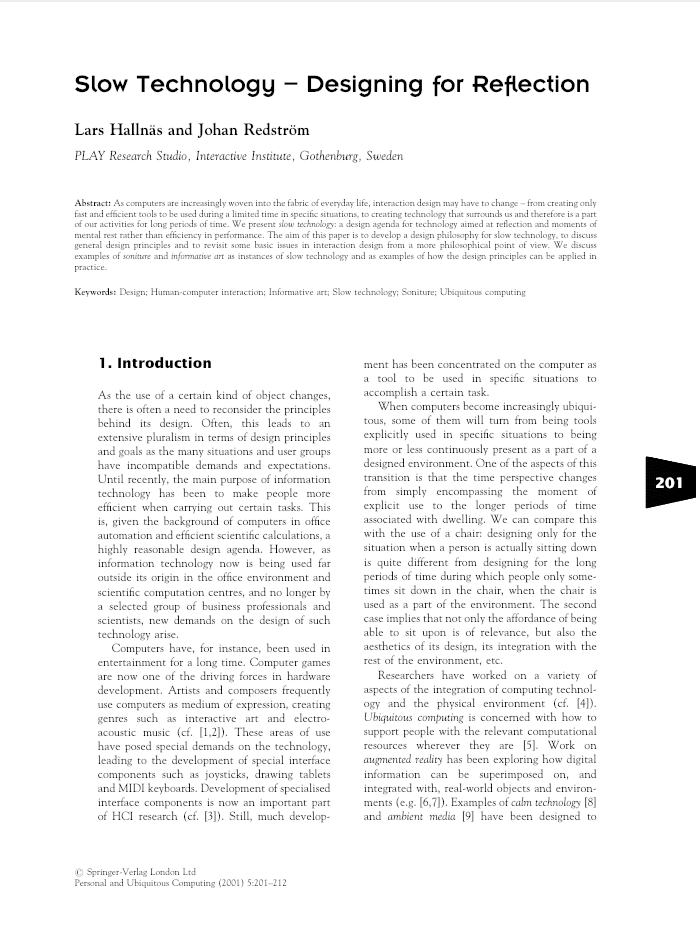
Hallnäs, L., & Redström, J. (2001). Slow technology--designing for reflection. Personal and Ubiquitous Computing, 5(3), 201–212.
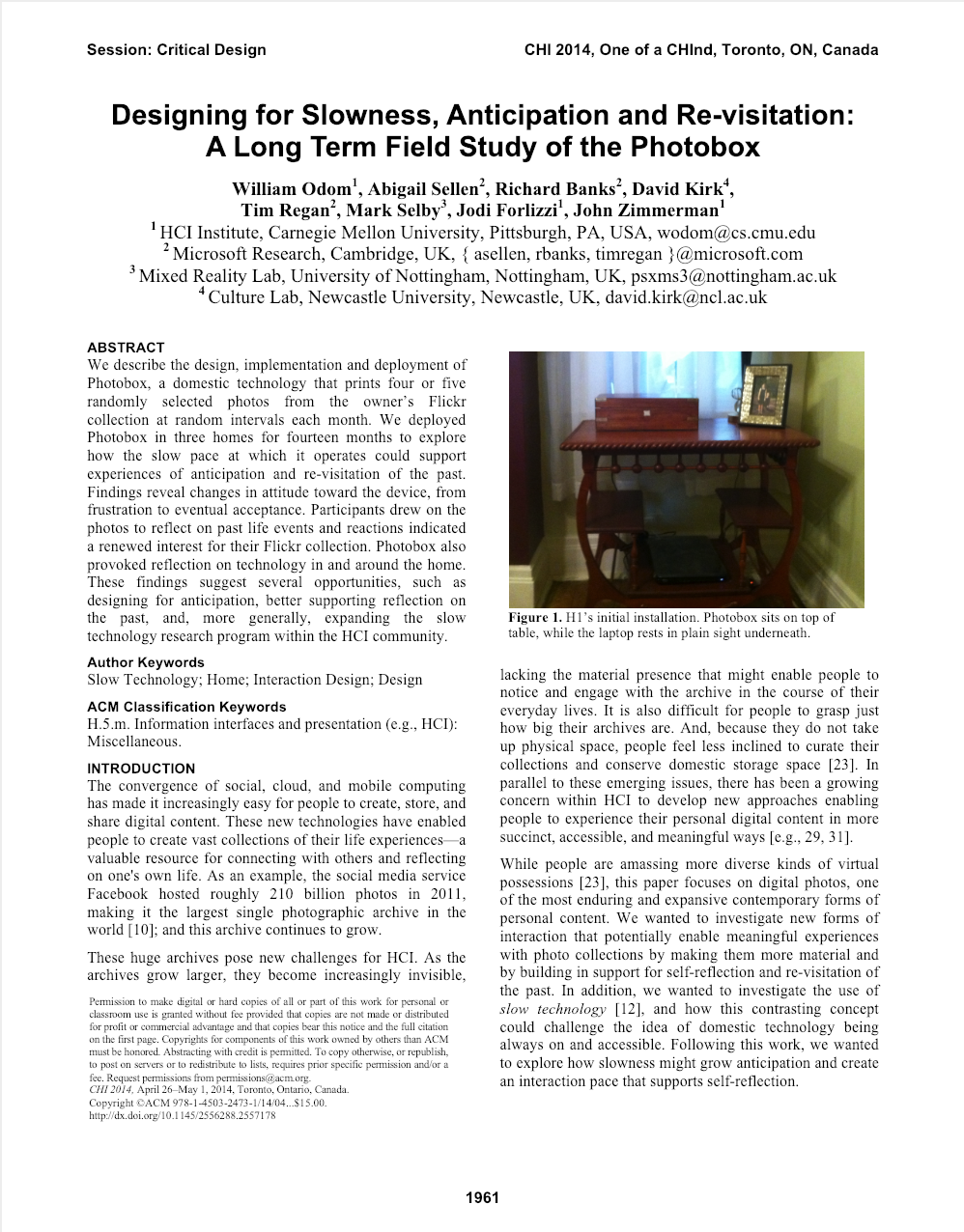
Odom, W. T., et al. (2014). Designing for Slowness, Anticipation and Re-visitation: A Long Term Field Study of the Photobox. In Proceedings of the 32Nd Annual ACM Conference on Human Factors in Computing Systems (pp. 1961–1970). New York, NY, USA: ACM.

2 Comments

1 Comment

Some Ideas About How Environments are Restorative

mountain.png

Lately I’ve been reading about what makes environments restorative — those secret spots we go to feel whole, or grounded, or to be reminded of who we really are and what it’s really all about. What is it about those places? And are they only places? Or are they also the things we do when we’re in them?

There’s a good bit of literature out there already and I’m only scratching the surface of it at this point. However, I’ve scratched down enough to articulate some distinctions between the ideas people have and so I thought I’d write them up in an effort to share what I’m learning and also to watch how my understanding of these concepts evolves over time.

tree.png

Attention Restoration Theory (ART) is an idea by Rachel and Stephen Kaplan, and I’ve blogged about it before. In ART, your attention is depleted by the demands of an environment and to restore it, you must get into an environment that has certain very specific features or conditions. It must feel like you’re 1) getting away, 2) that where you’re going is explorable and structured enough without feeling overwhelming or unsafe, 3) that what you want to do while you’re there is socially and physically possible, and 4) that it holds your attention without depleting it. This last quality, called fascination, is the magic of ART. It’s where the restoring bit happens.

water.png

Stress Recovery Theory (SRT) is an idea by Roger Ulrich. In SRT, one experiences stress and seeks out a restorative environment to recover. Nature, in particular water and vegetation, are especially restorative because from an evolutionary perspective, we perceive them as a resource rich (we will be more likely to survive near water and vegetation so it calms us). SRT is highly dependent on visual perception, and is a theory that relies on emotion: when we enter an environment, our bodies (and hearts) respond first, then our brains. We may cycle through memories and think about a space once we’ve had that initial emotional response, but the emotions are primary, and if we feel preference or aversion, those instincts will lead our way. In SRT, certain qualities of an environment are likely to cause us to calm down. The aforementioned water and vegetation are two (he calls these “natural features”), but there are others such as complexity, structure, depth and ground surfaces. These words have special meanings that I may blog about later, but essentially they all result in the perception that an environment is non-threatening, lacks tension, and is interesting.

house.png

And last, there’s Information Processing Fluency Theory (IPFT — sounds like a Myers Briggs score). This is a theory by, as best I can tell, Yannick Joye. I’m just digging into it and it’s far less cited or popular (and far newer) than the other theories, but here’s what I perceive the idea to be. Joye thinks we are not restored by nature, per-say, but by environments that are easy to process. This agrees and disagrees with parts of ART and SRT. For example, both theories suggest this concept in their own ways (“fascination” in ART is close, so is “complexity” in SRT), but neither theory relies on it the way IPFT does. Joye thinks nature’s restorative because it’s easy to process and he thinks it is easy to process because there is much “self-similarity” thanks to how fractal-based nature is. (I’ve got to admit that’s kind of clever.) What this does for restorative environments is that it opens up what’s eligible. Now, we can look at built environments as naturally restorative if we are (for a whole hosts of reasons, I’d imagine) highly fluent in processing the information within them.

So there. That’s what I’ve got today. I’ve a ton of reading and thinking still to do about all this, but how very interesting it is to explore these ideas and see how they respond to 1) contemplative space (as opposed to restorative space) and 2) pervasive and persuasive technologies that abound in nearly every space we go. More! Soon!

If you want to dig in more, might want to give these papers a read:

Kaplan, S. (1995). The restorative benefits of nature: Toward an integrative framework. Journal of Environmental Psychology, 15(3), 169–182.

Ulrich, R. S. (1983). Aesthetic and Affective Response to Natural Environment. In I. Altman & J. F. Wohlwill (Eds.), Behavior and the Natural Environment (pp. 85–125). Boston, MA: Springer US.

Joye, Y., & van den Berg, A. (2011). Is love for green in our genes? A critical analysis of evolutionary assumptions in restorative environments research. Urban Forestry & Urban Greening, 10(4), 261–268.

1 Comment

Comment

Restorative Environments

To create a map of restorative space on UW's campus, I’ve been researching what makes space restorative and I've come across the following framework from the Rachel and Stephen Kaplan. Big caveat before reading: Work in progress alert. I am constantly learning and reshaping my understanding of these concepts.

Rachel Kaplan is a professor emeritus at the University of Michigan. Stephen Kaplan, also a professor emeritus at UM, passed away this summer. Together and individually, they’ve authored many seminal works exploring how and why access to nature matters to human health and well-being.

Researchers Stephen and Rachel Kaplan, Photo Credit: University of Michigan

Researchers Stephen and Rachel Kaplan, Photo Credit: University of Michigan

Kaplan, S. (1995). The restorative benefits of nature: Toward an integrative framework. Journal of Environmental Psychology, 15(3), 169–182.

Kaplan, S. (1995). The restorative benefits of nature: Toward an integrative framework. Journal of Environmental Psychology, 15(3), 169–182.

So, what exactly is getting restored by a restorative environment? According to the Kaplans, it’s attention. They argue that attention is a limited, deplete-able resource and certain environments, nature being the best example, can fill that depleted attention reservoir right back up (they call this attention restoration theory). In order for an environment to restore one’s attention, it must have the following four qualities at once: being away, fascination, extent, and compatibility.

The first quality is that the environment gives a sense of being away. For an environment to be restorative, it must feel like you have escaped or withdrawn from your ordinary (attention depleting) environment.

The second quality is that the place you escape to must be interesting, it must have fascination. Fascination is tricky because there are fascinating things that are not restorative, for example a train wreck or some trollish Twitter thread. Fascination in the Kaplan’s sense is a magical (that’s my word) quality of an environment where your attention is held but not drained. To better approximate this non-draining quality of fascination, some use the phrase soft fascination (like a walk in nature) as distinct from hard fascination (like a riveting television show).

In addition to being away in a fascinating space, the third quality a restorative environment must have is extent. That is to say it must feel like “another world” entirely from the one you’re escaping. To have extent, this “other world” must be explorable without being overwhelming. Places with extent strike a good balance between 1) having lots to explore, and 2) giving you the freedom to do so, while 3) also having enough structure so you feel safe, without 4) feeling like they’re full of restrictions and rules. It should be noted that the extent doesn’t have to involve physical space, it can be an internal experience, too.

And then on top of everything, the fourth quality a restorative environment must have is compatibility. There must be a rightness to how you want to use the space and what the space is for. If you found a spot that met the other requirements (it was away from it all, had soft fascination, and plenty you were eager and safe to explore), but wasn't made for that purpose or didn't accept your presence there, it wouldn't be restorative. Indeed, it might be quite stressful or frustrating. To be restorative, the space has to work for you and you have to work for the space.

Comment