Comment

Great Lengths: Setting Boundaries with Facebook

facebook.png

In December 2017, I “quit Facebook,” by which I mean I chose to deactivate my account. Many months later, I woke in the middle of the night thinking of someone I’d met in Newcastle Upon Tyne who had been very kind to me, but whose name I could not remember. I realized the only place I could go to find her name was Facebook. It was as if she lived “in Facebook” to me, the way people live in Durham, NC or Seattle. The idea (and clever portmanteau) of a “Facation”—a vacation to the “land” of Facebook—occurred to me and thus began my boundary-setting experiment with this technology. 

I made plans to visit Facebook like I would visit Durham, NC, where I used to live. I thought of all the people I’d want see and catch up with while I was there. I thought about all the things I’d want to tell them about my life. I envisioned us sharing an asynchronous cup of coffee across time and space, remembering and reveling in each other. 

As I would with any vacation, I bounded my Facation to a set number of days (a week), set a date (the last week of the year) and I made a plan. At the end of 2018, I reactivated my account and made my first post. I told everyone I’d be there for a week and couldn’t wait to catch up. Each day, I went through sections of my friends list and clicked on the pages of people I wanted to check in with. I wrote a single, lengthy, picture-filled post each day about my life. Dozens of people chimed in on the comments with their encouragements, commiserations, and own updates. I maintained several chatty back-and-forth conversations through private messages. A week later, I said my goodbyes and see-you-next-years and deactivated again, re-entering the blissful world of (effectively) not having a Facebook account. A year later, I repeated my Facation and it was just as life-giving, connecting, and worthwhile.  

I imagine a future where we collectively plan annual “digital reunions,” gathering as one big group in some digital locale where everyone invests in creating thoughtful, robust, and connective content. Until then, I’ll continue to hold this complicated and fraught technology at arms length—distancing myself from the platform while doing my best to avoid distancing myself from those I hold dear that live upon it.

Comment

4 Comments

Great Lengths: A Blog Series About Setting Boundaries with Social Media

There’s an entire industry built around harvesting our attention for corporate financial gain. It’s called the attention economy. The more attention we pay to a website, game, video, or app, the more advertising and data-tracking those media can do. To keep us coming back, tech companies deploy a method called behavior design (it’s also been called persuasive technology and captology). Using lessons learned from early psychological investigations, such as BF Skinner’s pigeons pressing levers for food, modern day psychologists have created a formula to get humans to press buttons for likes. This formula uses pain and pleasure, our hopes and fears, and the promise of social acceptance and threat of rejection to motivate our behavior. 

Lecture 4 — Tue Oct 8 2019-2.jpg

Increasingly, designers and programmers are building addictive technology that causes and/or regulates the release of dopamine in our brains. Some apps and websites actually “dose” dopamine by withholding information, like how many likes a photo has on Instagram, so it can burst that information later and all at once, effectively dosing a larger “hit” of dopamine and making it more likely that we’ll to return sooner for another. 

This is one reason why it is a common experience to lose time while on Facebook or Instagram or Youtube. The consequences of this lost time aren’t confined to what we might have done instead—our attention is impacted as well. This is because attention is fatiguable, and when we spend it scrolling endless streams and auto-playing content, we have less energy to attend to things that may matter more.

I believe we can have greater agency over how and when we attend to technology. As a PhD student, this belief motivates much of my research. Over the course of the next month, I intend to write a series of blog posts that describe the strategies I use to set boundaries in my use of technology.  With these posts, I hope to generate and lively and convivial dialogue about mitigating (or at least minimizing) the harms of the attention economy while allowing for (or even maximizing) the positive effects technology can have in our lives. Stay tuned.

4 Comments

Comment

Community Building in the Classroom

This is the first course I have ever taken that encouraged students to engage with each other on a very human level. This allows for much deeper connections to be made, and I was surprised at how quickly my peers began to feel more like friends.
— Informatics Undergraduate

I have begun to begin and end my quarter with an Impromptu Networking activity to foster connection between students. It’s a low-stakes way to get folks meeting each other quickly, and it’s easy to take those 1:1 conversations and share them group-wide. Based on reflections from students, which are peppered throughout this post, it seems to have a powerful effect on how they see each other, and how they see themselves.

The Setup

First, I ask folks to stand up, if they’re able. This immediately infuses the space with energy. Then, I explain the rules.

  1. Find a person to chat with. Raise your hand if you haven’t found someone so you can easily find someone without a partner.

  2. When I say “begin,” one person in the pair should begin answering the question on the board (see below).

  3. When I ring the bell once, switch so the other person in the pair shares their answer. (I use a bell because my voice doesn’t carry well in a loud room. If I don’t have a bell, I’ll knock an Expo marker against a whiteboard for the same effect.)

  4. When I ring the bell twice, everyone look at me. (When I have everyone’s attention, I tell them to find a new partner.)

  5. Repeat. (I go three rounds.)

For my class, we focus on designing restorative experiences for undergraduates, so the first conversation I want to seed is a conversation about why undergraduates need to be restored in the first place. I ask students to discuss their reactions to the following prompt, which I display on the class projector: “What, if anything, do you find stressful in your life and how do you cope?”

 
Stress Prompt.jpg
 
I think through these deeply personal and vulnerable conversations about what we are going through (eg. stress) we can learn a lot from each other and grow closer to one another. 
— Informatics Undergraduate

Mapping the Conversation

This activity generates a lot of energy. As a facilitator, you can transfer that energy into the next activity. It may seem scary, especially if you don’t feel confident with your handwriting or spelling, but I encourage you to take the question you’ve just asked the room, and chart out the answers on a whiteboard where the conversation can be visualized. This map becomes a way to generate more conversation and creates a co-created artifact of their one-on-one conversations. For example, for the prompt above, I drew two circles on the whiteboard and wrote “STRESS” in one and “COPING” in the other. I then asked students, “So, what’do you find stressful?” and started mapping out their answers. When the contributions began to slow, I asked, “What are we missing?” When that tapped out, I said, “Okay, so what sort of things do you do to cope?” and we started mapping that.

Stress Map 1.jpeg
Stress Map 2.jpeg
As a student, sometimes I’ll have felt loneliness as I feel I’m the only one struggling while everyone’s a step forward. During the first week of class, I remembered when the class listed down what made them stressed as college students. I remember listening to my peers and I was surprised to resonate with their experiences and feelings.
— Informatics Undergraduate

Scaffolding Conversations

Stress is a pretty easy thing to connect to and talk about for undergraduates, so I asked students to discuss that with each other without too much scaffolding. However some topics benefit from a solo activity beforehand. I do this in the hopes that the activity will enable them to approach each other with more confidence. This is, I suspect, a way to ensure more authenticity, for they aren’t approaching each other with as much fear.

For example, in the last class of the quarter, we had another series of conversations, but this time we discussed gratitude instead of stress. We’d been focusing on what’s wrong in the university all quarter, but there are many things right about it at the same time. Focusing on gratitude ends the class on an upbeat, generating positive (but complicated) feelings towards the system we’re a part of, and towards each other.

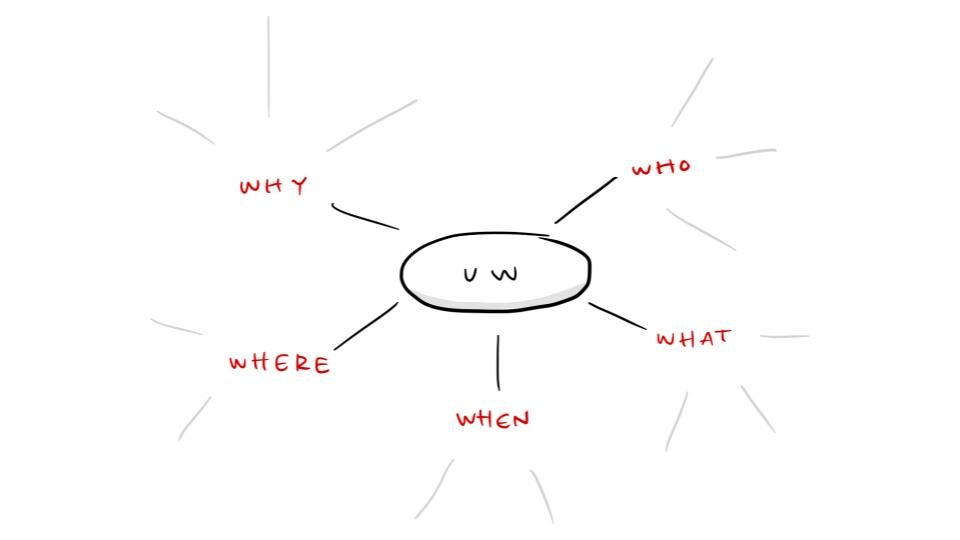
Since feeling and expressing gratitude can be a bit scary, I asked individuals to create a gratitude map before they talked with each other. Everyone grabbed an 11x17 piece of paper and a couple of Sharpies (red and black) and then drew a circle in the middle and labeled it UW. They then were asked to draw five spokes from the center: who, what, when, where, why.

 
Lecture 19 — Thu Dec 5 2019.jpg
 

I gave folks time to fill out the map and then they took the map with them to each round of conversation, which asked them to discuss, “Where does your gratitude reside within the system? What do you feel most connected to in this moment?” From those three rounds of conversation, we immediately transitioned into mapping the one-on-ones as a larger group, just as before.

 
Gratitude Prompt.jpg
Gratitude Map.jpeg
I have learned to be more open, not afraid of being myself in a classroom setting.
— Informatics Undergraduate

Trusting students into speech

Throughout this post, I have pasted quotes from my students’ reflections on how these conversations affect them. It’s these quotes that encourage me to keep creating opportunities for students to be real with each other. I want to also acknowledge that it can feel scary to ask a room that may or may not trust you yet to do something that requires vulnerability. We have probably all been witness to someone we didn’t trust trying to draw out of us what we weren’t willing to give. But be careful to not let those old experiences stop you. The way through is to trust that students are up for the task of being a “more open, not afraid” version of themselves. They can sense that I truly value and eagerly anticipate what they’re going to say (and I do!). While invisible, this perceivable quality of my intention infuses the room with trust. Students speak into that.

Comment